Different roles. Different training. Equally valuable.
There is sometimes confusion about the difference between a Lipspeaker and a British Sign Language interpreter (TSLI/RSLI). While both are communication professionals who support Deaf people, their roles, training and professional competencies are different. Understanding this difference is important because Deaf people should be able to choose the communication support that best meets their individual needs.
What does a Lipspeaker do?
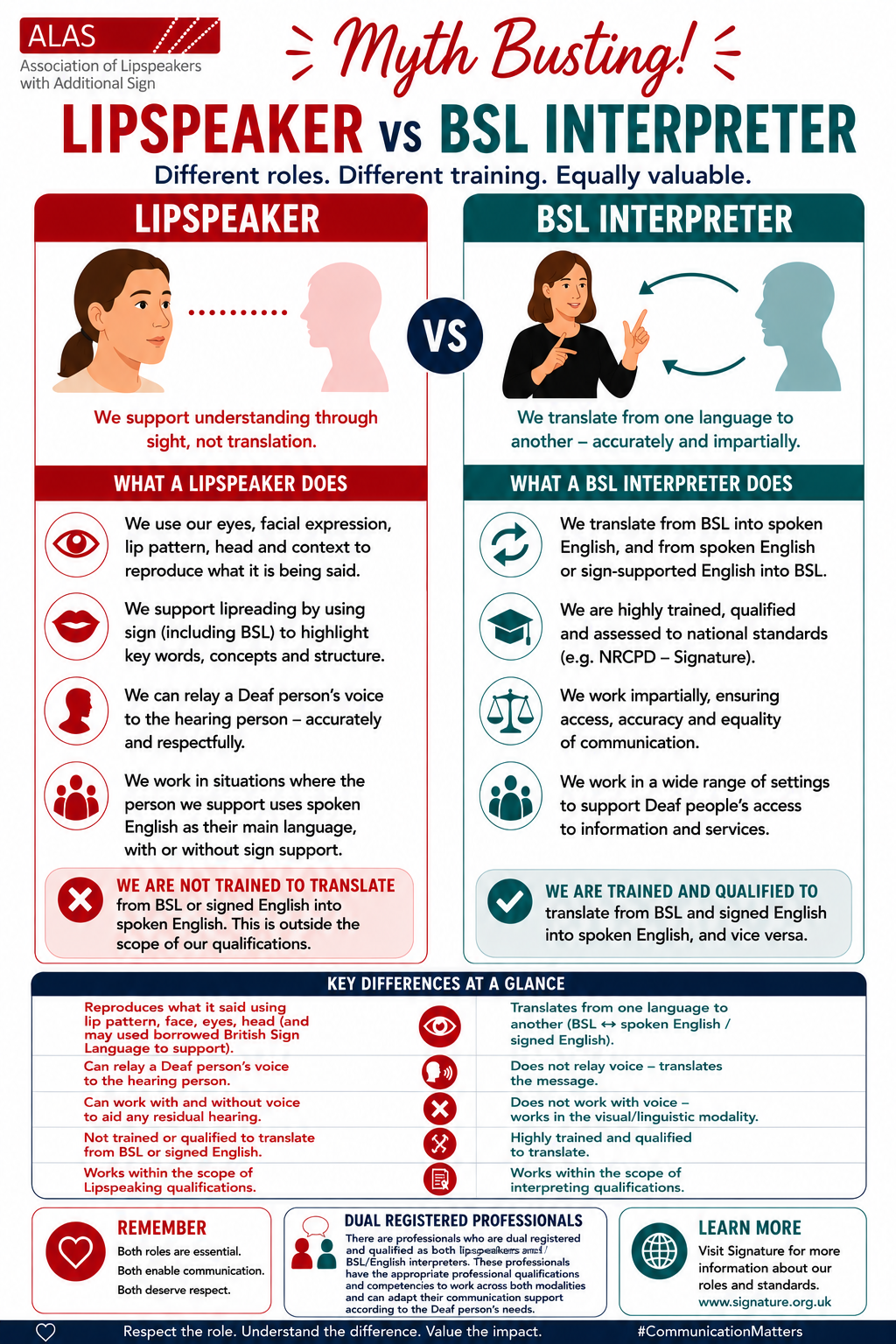
A Lipspeaker is a hearing professional who has been trained to make spoken English easier to lipread. A Lipspeaker reproduces what is being said using clear lip-pattern, facial expression, eyes and natural gesture, helping the Deaf person access spoken English visually. Lipspeakers may also use additional communication strategies, including borrowed British Sign Language, where appropriate and within their skills, to support meaning and understanding.
A Lipspeaker may also:
- Relay a Deaf person’s voice to a hearing person.
- Work with or without voice to support any residual hearing.
- Use fingerspelling or additional signs to support difficult words, names, concepts or meaning.
- Adapt their communication to the individual Deaf person’s preferences and needs.
- Work across a wide range of settings, including health, education, legal, community and workplace environments.
So, can a Lipspeaker interpret BSL into spoken English?
Lipspeaking qualifications do not train or qualify a practitioner to interpret BSL or Signed English into spoken English. Language interpreting requires its own specialist training, assessment and professional competencies. Interpreting BSL into spoken English is therefore outside the scope of a Lipspeaker’s Lipspeaking qualification unless that individual also holds the appropriate interpreting qualification and professional registration. Likewise, being able to use some BSL as a Lipspeaker does not automatically make someone a BSL/English interpreter.
Being able to sign is not the same as being qualified to interpret.
What about professionals who are qualified in both?
There are professionals who are dual registered and qualified as both Lipspeakers and BSL/English interpreters.
These professionals have the appropriate professional qualifications and competencies to work across both modalities. This means they can adapt their communication support according to the Deaf person’s needs, provided the assignment falls within their professional competence. It is important that their two professional roles are not confused: they are drawing on two distinct sets of professional skills and qualifications.
Why does the distinction matter?
A Deaf person who relies primarily on lipreading may specifically require a Lipspeaker who is trained to produce clear, accessible lip-patterns and who understands how to use facial expression, visual information and additional sign appropriately. Another Deaf person may prefer to communicate primarily through BSL and require a qualified BSL/English interpreter. Some Deaf people may benefit from a combination of communication approaches, while others will have very specific preferences. There is no single communication solution that works for every Deaf person.
Lipspeakers and BSL/English interpreters have different roles, different training and different professional competencies – and both are valuable.
What matters is ensuring that Deaf people, employers, agencies and service providers understand those differences so that the right professional can be provided for the right communication need.
Different roles. Different training. Equally valuable.
Respect the role. Understand the difference. Value the impact.
For more information about Lipspeaking and Lipspeaking with Additional Sign, visit the ALAS website and explore our resources and members directory.