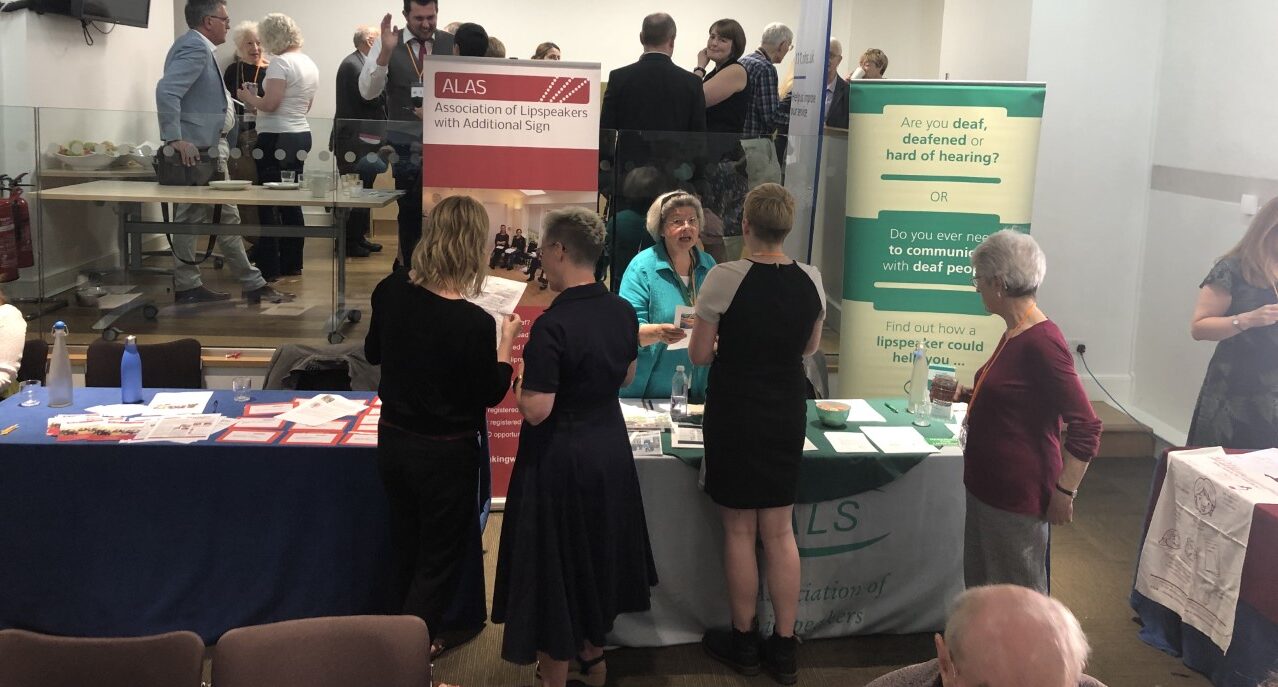
The Association of Lipspeakers with Additional Sign (ALAS) was created in 2017, as a response to the communication needs of deaf people. It’s about choice for the deaf person; having communication support that best suits the deaf person’s needs.
The idea of adding borrowed BSL signs to the lipspeaker skill set was first introduced to the ALS Committee in 2004. Although it was initially met with resistance for a number of years, the concept evolved, and by around 2010 the idea of promoting Lipspeakers who could also sign began to take shape.
In March 2017, Lesley Weatherson (lipspeaker and British Sign Language Interpreter) presented to the ‘National Registers for Communication Professionals working with Deaf and deaf blind people’ (NRCPD) board a new association. This proposal was in response to the strategic plan for communication professionals, registration and standards. The idea was debated by the board and the Chair concluded in summary that the association was welcomed and needed.
In 1947, Muriel Shepherd (MBE) got together with the late Bill Snowdon, a teacher of the deaf (ToD) in South Shields, and began to create the art of lipspeaking. Muriel then took the skill to the conference of the newly-formed ‘British Association of the Hard of Hearing’ in London, where she showcased the newly created skill for the audience.
Muriel then joined forces with Lynne Dubin, another driving force at the time, and founded what was the Association of Lipspeakers (ALS). Lynne was a pioneer of lipspeakers training. She recorded a number of different audio passages for Lipspeaker Training, which are still used to teach and train Lipspeakers today.
Here is one short clip recorded by Lynne ‘How to live like a Millionaire’.
As the lipspeaking profession has evolved, it has been shaped and strengthened by dedicated practitioners who have shared their knowledge, refined techniques and supported the next generation of Lipspeakers.
One particularly instrumental figure in this history is Sara Scanlon. Widely known as the “Queen of Paring Down” Sara was celebrated for her exceptional ability to distil spoken language into its clearest, most accessible form. Her skill lay not only in technical precision, but in her deep understanding of how to make communication truly meaningful and effective for Deaf individuals. Sara championed ‘paring-down’, an integral part of Lipspeaking today.
ALAS created a new website which included a directory for lipspeakers to advertise their BSL skills, working areas and contact information. We have two types of members:
Full Members: Fully qualified NRCPD registered level 3 Lipspeakers, with a minimum skill competence of British Sign Language (BSL) level 2.
Associate Members: A mixture of qualified lipspeakers with either no or minimal BSL skills, student lipspeakers, and other supporters of ALAS.
This meant that there is now one directory for lipspeakers who can offer this type of support.
The previous Association of Lipspeakers (ALS) stopped operating as an Association. Its website sits dormant and information is currently out-of-date. This means that ALAS is now the only Association supporting professional Lipspeakers, both with and without addition BSL skills.
Sign supported lipspeaking is nothing new. It’s recognising in a more formal way, a service that will hopefully give rise to a national occupational standard (NOS). A qualification is now available to the set standard. This qualification will be based on vocabulary competence rather than on BSL linguistics and will be a qualification to assess competency against, to protect the user and registrant.
At present, there is still no NRCPD category therefore anyone can call themselves a ‘Lipspeaker with Sign’. This means that when booked, unless a Level of BSL competence is specifically specified, a lipspeaker with Level 1 BSL could be booked. We encourage all deaf people to specify at the time of booking what level of BSL competence they need.